CASE STUDY
Improved UI Builder usability by building a content design practice
My approach to building a content design practice is to build rapport, set up recurring office hours, create reusable artifacts, and establish prioritization with leads.
This case study — about guiding the UI Builder product team into becoming a full-stack content design organization — shows how my approach delivers real business impact.
Source: ServiceNow Community
Context
ServiceNow is a platform that businesses run their operations on.
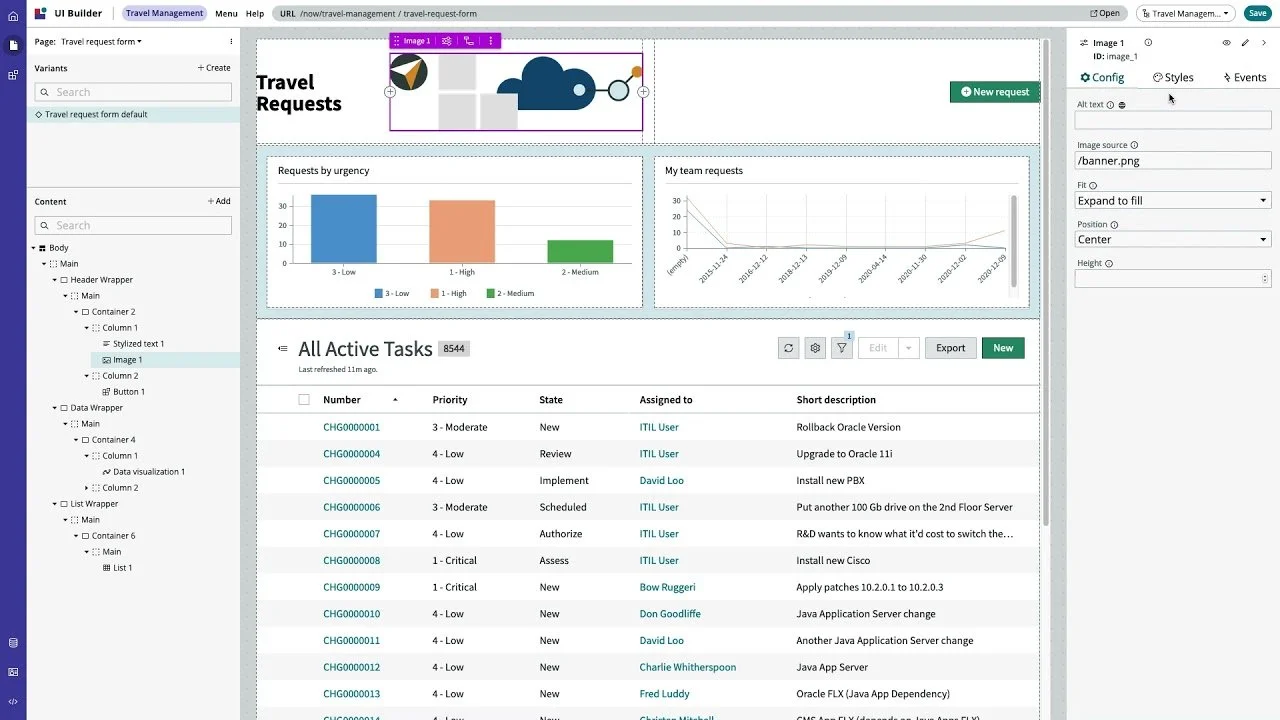
UI Builder (UIB) is a tool for creating app interfaces on the ServiceNow platform.
The mid-skilled developer is the main UIB user — familiar with web apps but not a pro coder.
Problem
UI Builder was having serious usability issues across multiple features, but I was limited in my ability to address all of them.
In an ideal world, I could engage early and often on all of the feature development for this single product. But on a team of 7 product designers and several engineering scrum teams, there was just too much to do for one content designer.
And to add to this problem, I was finding myself flooded with requests to do a “quick review” of the content. My calendar was filled with half-hour meetings booked back-to-back, all requiring constant context switching and none of them allowing me to work as a co-owner of the design work.
If I was going to make a meaningful impact on the content, I would have to change my operational strategy.
Solution
I systematically addressed the laundry list of usability issues by scaling my contribution. I upskilled designers, created reusable artifacts, and collaborated with team leads to prioritize my contribution.
I upskilled designers by setting up office hours where designers or product managers could book time with me in advance. Not only did this solve the problem of purging my calendar of all the ad-hoc content reviews, but also I got a chance to use these sessions to share my rationale. If I was asked by a designer whether an error message was good or bad, I show (rather than tell) the way I reference the style guide or use tools like Hemingway to review the copy. Eventually I had designers showing me how they applied my methods without me prompting them.
I also created reusable artifacts for when I found myself giving the same feedback across multiple features. I started keeping a word list so that we were all using terms like “experience,” “page,” and “variant” consistently. I created content patterns so that we had consistent labels for objects like data resources and page templates.
And I started negotiating my time commitment with the design lead and the product management leads. Once a quarter, we would meet to:
Come up with criteria to assess the priority of a certain feature
Stack rank features by priority using our criteria
Assign my level of engagement on each feature
We used the RACI model to define my level of engagement. We agreed that it made sense for me to be Responsible only for 1-2 features per release, so usually the top-ranked feature was what I spent 80% of my time on. Then I would usually be slotted as Consulted or Informed on the remaining features down the list.
Approach
When I set out to change my operational strategy on UI Builder, the first hurdle I had to jump was building rapport.
I realized that it was going to be difficult to ask people on my team to jump through various hoops (book office hours, use templates, etc.) if they didn’t trust my judgment — or even know who I was, for that matter.
So the first baby step I took was setting up recurring one-on-one meetings with different designers on my team. I would intentionally set no agenda, even saying no to ad-hoc content reviews. These one-on-one meetings were just a space for me and the designer to chat at a high-level about what we’re working on. A relationship started to develop to where designers would want to help me out with scaling my contribution. I found that after gaining rapport, designers were more willing to be unskilled, use reusable artifacts, and accept the negotiated-upon level of engagement for their feature.
Impact
Over the course of several releases, UI Builder saw marked improvement in usability, as attested to by developers using it on a regular basis.
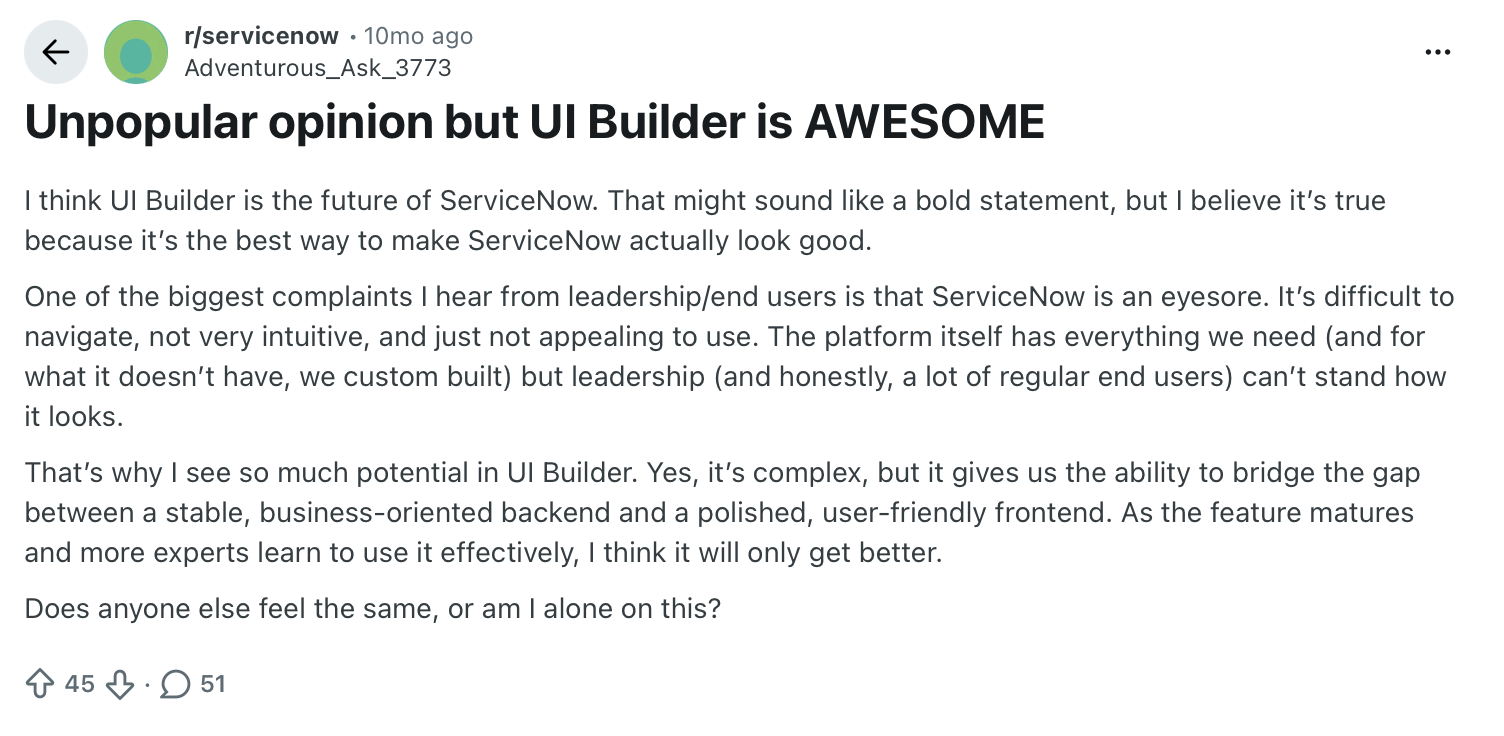
One in the r/servicenow subreddit said in November 2025 that they see “so much potential” in UI Builder.
“Yes, it’s complex, but it gives us the ability to bridge the gap between a stable, business-oriented backend and a polished, user-friendly frontend. As the feature matures and more experts learn to use it effectively, I think it will only get better”
Source: Reddit
Another Reddit user shared in November 2025 that they’ve changed their opinion on the product.
“While I also didn’t like it in previous release, I started to like it in the most recent iterations… I also think it’s the future and here to stay”
Of course, other Reddit users like BasedPontiff acknowledge that UI Builder has improved but still think it has a long way to go.
“The worst part is that it is waaaay better than better than it was 5 years ago and it still sucks”
Takeaways
Working on this project reinforced some key lessons for me:
For better or worse, product quality is a symptom of team culture. As much as I try to hone my skills in UX design and writing, I only get to practice those skills when I have a seat at the table. And that’s where the work of building relationships and shaping the team culture really come to the fore.
Advocating for my seat at the table is the job. It’s so easy to feel as though I’m doing something wrong if I have to constantly tell people why my job is important. But working on this project, I knew that I had a perspective to bring that might not otherwise be accounted for if I weren’t in the room. And so in order to deliver a clear user experience, I had to tell stakeholders plainly that I need to be part of the decision-making process.