CASE STUDY
Unlocked 85% agent redeployment by drawing a clear line between AI and human
When it comes to driving content design for strategic initiatives, my approach is to get in early, stress test against real-world scenarios, and deliver artifacts that scale content while ensuring quality.
This case study — about shaping the content and design for the Autonomous Workforce product line — shows how my approach delivers real business impact.
Context
ServiceNow is a platform that businesses run their operations on.
An AI specialist handles all tasks for an entire role, like IT ticket resolution.
The Autonomous Workforce is ServiceNow’s product line of AI specialists.
Problem
Customers didn’t want to adopt AI specialists if it wasn’t clear how they differ from human workers.
The Autonomous Workforce introduces the next iteration in enterprise AI. Unlike traditional AI assistants or chatbots that only suggest solutions, AI specialists diagnose problems, execute decisions across systems, and handle operations autonomously.
But the move toward a new paradigm introduced a new challenge: if an AI specialist is proactively taking on a human’s workload, then how will someone know when AI did something versus a human? If someone interacts with an anthropomorphized AI specialist, will they bring inappropriate expectations?
Solution
I helped shape guardrails against anthropomorphizing AI specialists, as well as delivered content patterns around communicating AI specialist value to humans, so that it was clearer how AI specialists are different from human workers.
We landed on the following standards:
Use a name that describes its business role; no human names
Use the company logo as the avatar; no humans or characters
Use it/its pronouns — not he/him, she/hers, or they/them
Overall, we decided to lean as far away from anthropomorphizing as possible. It was imperative that we make it clear that this AI entity wasn’t going to replace humans — its purpose is solely to support humans.
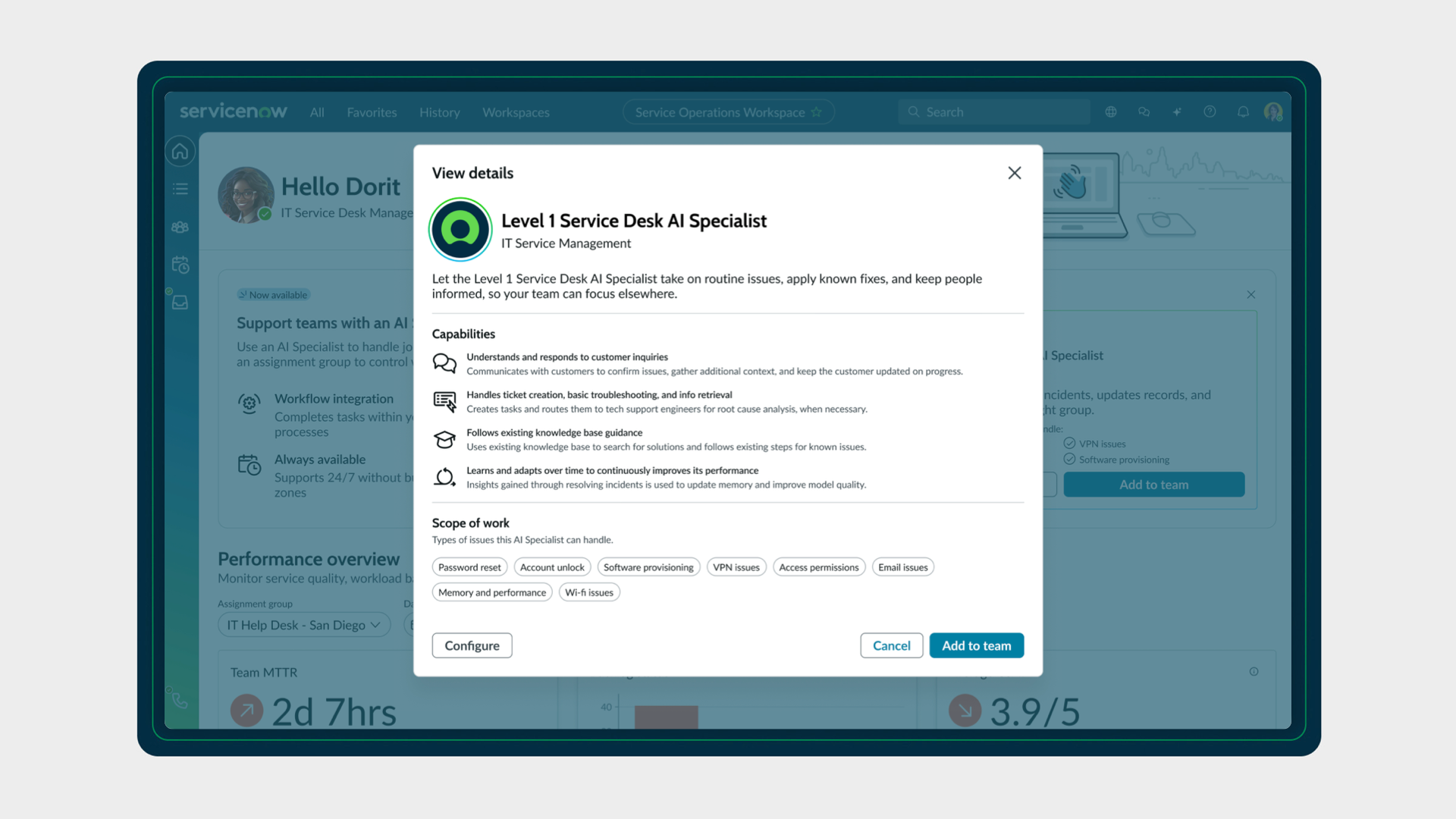
I created content patterns that aligned to this direction. For example, I structured the AI specialist description to communicate (1) the specific business processes it automates and (2) the value that the AI specialist brings to a team by automating these processes.
Let me show you how I arrived at this solution.
Approach
I first joined the project when we were tasked with creating a demo for an executive. He wanted to see us explore the idea of some AI entity autonomously resolving incidents end-to-end for the IT service desk. What we came up with was the L1 IT Service Desk AI Specialist.
But we soon realized that what we were working on had potential to support customers beyond just the IT service desk use case. What if it could automate entire business roles for other departments, like human resources or finance?
So while working on short-term execution of the L1 IT Service Desk AI Specialist, we also started planning for how AI specialists might scale in the long-term.
And that is where we started working through some interesting questions:
How do you explain AI that appears like a person but isn’t one?
What language avoids anthropomorphizing while staying approachable?
How do you create patterns that work for diverse AI specialist use cases (service desk, cloud operations, finance, etc.)?
Everyone started bringing their ideas to the table, including me. I remember some designers showed concepts where an AI specialist had a
I started getting concerned that we were seeing all of these decisions as binary. Stakeholders were divided along two lines: make the AI specialist as human-like as possible or make it as clear as possible that this is just a robot. I wanted them to see that we had a spectrum to choose from, so I developed a matrix and talked through it with the team.
I did this for a few reasons. For one, I wanted to influence away from making the AI specialist too anthropomorphic. I felt it would be in poor taste to make the AI specialist very human-like if human workers already felt threatened that this AI entity was going to take their jobs. I thought it could actually be an adoption blocker that would blow back on us. I also thought it would be risky to even try to make the AI specialist as realistically human as possible, otherwise it lives in the uncanny valley and would just be a cringey product.
I also know that in order to get stakeholders to change their minds, they have to think it was their own idea. So rather than hand the pro-anthropomorphization stakeholders a radically different vision, I thought instead I might show them that there are even smaller steps away that they can take. Instead of choosing between a realistic human profile pic or a robot avatar, we now have a third option to choose a cartoon human avatar. I also wanted stakeholders to see that they could mix-and-match decisions, rather than just all-or-nothing.
Overall, we decided to lean as far away from anthropomorphizing as possible, which is reflected in the solution above. It was imperative that we make it clear that this AI entity wasn’t going to replace humans — its purpose is solely to support humans.
Impact
We saw meaningful adoption of the first AI specialist — the L1 IT Service Desk AI Specialist — proving out the value of the entire Autonomous Workforce.
ServiceNow’s own service desk saw marked improvement in key metrics because of the L1 IT Service Desk AI Specialist:
90% of IT support requests handled autonomously
96% resolution efficiency (improved from 81%)
85% of IT support agents redeployed to higher value work
The City of Raleigh, reported a 98% deflection rate using the L1 IT Service Desk AI Specialist. “We’ve saved the equivalent of a full month of time,” said Mark Wittenburg, chief information officer at City of Raleigh.
L1 IT Service Desk AI Specialist was demonstrated live at Knowledge 2026 to over 25,000 attendees. Executives shared the value of the Autonomous Workforce and even announced that 20 more AI specialists will be released.
Overall, the market got to see the real value of AI specialists. What the high adoption and success rates of the first AI specialist tell me is that customers got the clarity they needed to trust the Autonomous Workforce.
Takeaways
Working on this project reinforced some key design lessons for me:
Design is so much more than pixel-pushing. I got to influence key decisions for the user experience by working outside of the Figma file — in Zoom calls with product managers, Teams messages with designers, and even just on the paper notepad on my desk.
Advocating for my seat at the table is the job. It’s so easy to feel as though I’m doing something wrong if I have to constantly tell people why my job is important. But working on this project, I knew that I had a perspective to bring that might not otherwise be accounted for if I weren’t in the room. And so in order to deliver a clear user experience, I had to tell stakeholders plainly that I need to be part of the decision-making process.
Toggling between execution and strategy is the best of both worlds. I can spend a whole day on a single tooltip message, and I can equally spend a whole day doing blue sky thinking. But having to go back and forth between the two mutually benefits each task. My detailed work is better for having a broader direction to move toward. My strategic work is better for being grounded in reality. I attribute the success of the Autonomous Workforce strategy to the success of the L1 IT Service Desk AI Specialist execution, and vice-versa.